

Narrow‑banded Rain Snake, Smithophis leptofasciatus, Mizoram
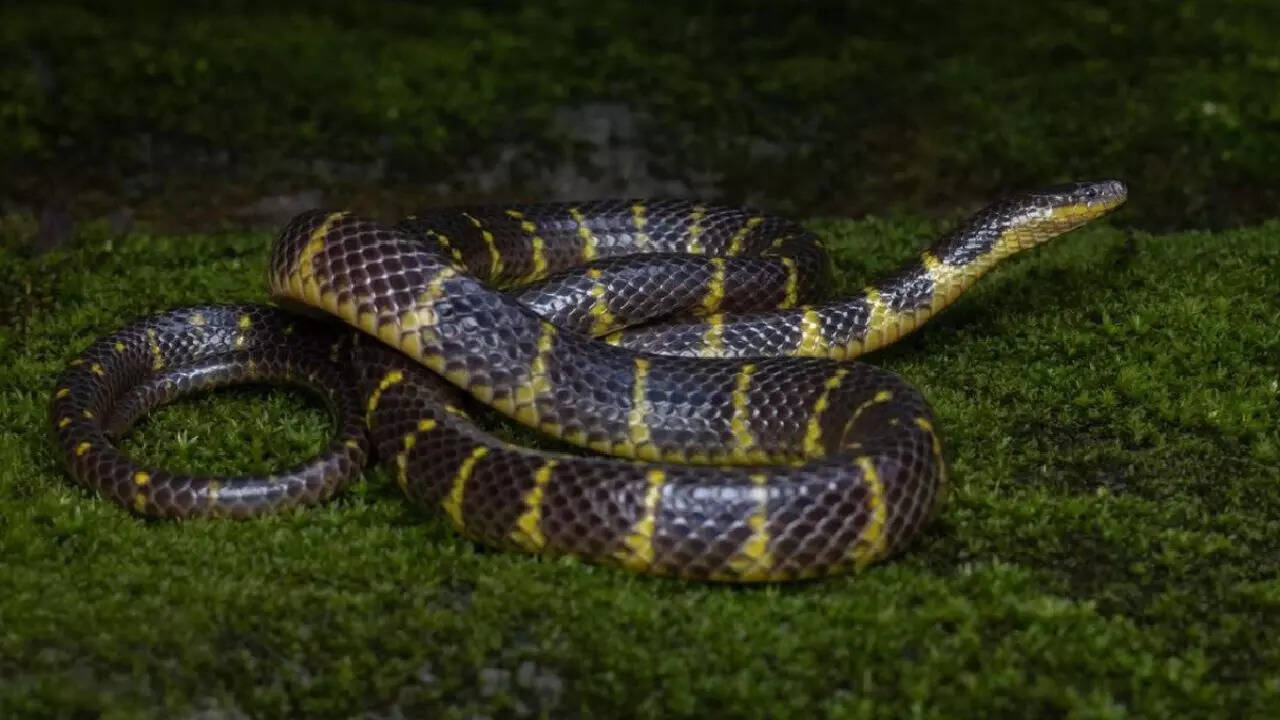
Narrow‑banded Rain Snake (Smithophis leptofasciatus)
Introduction
In the misty montane forests of northeastern India lies yet another example of the extent of biodiversity that remains undocumented. The Narrow-banded Rain Snake (Smithophis leptofasciatus) is a recent addition to the genus Smithophis, described in 2025 from the state of Mizoram. This discovery not only enriches our understanding of snake diversity in India but also underlines how even relatively large vertebrates can remain hidden in under-explored habitats. (The Times of India, India Today)
Discovery & Naming
-
The species was described by a team including Muansanga, Purkayastha, Hruaia, Vabeiryureilai, Biakzuala, Decemson, Lalremsanga & Bohra in 2025, published in TAPROBANICA (Vol. 14(2):158-165). Nova Taxa
-
The specific name leptofasciatus is derived from Greek/Latin: leptos (narrow) + fasciatus (banded), referring to its distinctive narrow dorsal bands. Nova Taxa
-
The common English name “narrow-banded rain snake” reflects both its banding pattern and its association with humid, rainforest/stream habitats. Locally, in the Mizo language, the tentative name “Ruahrul” has been proposed. India Today
Taxonomy & Phylogenetic Position
-
Genus: Smithophis Giri, Gower, Das, Lalremsanga, Lalronunga, Captain & Deepak, 2019. MDPI
-
Family: Natricidae (or some classification recognise as subfamily Natricinae of Colubridae)
-
According to the morphological and mitochondrial (cytochrome b) gene analyses, S. leptofasciatus forms a sister taxon to the clade containing S. atemporalis, S. bicolour, and S. mizoramensis. The genetic divergence from its closest relatives was reported at about 11.5%. Hindustan Times
-
With this description, the number of known species in this genus (especially in northeastern India) increases, emphasising the region’s importance for herpetological diversity. GKToday
Morphology & Diagnostic Features
-
Body slender, with the holotype measurements reported as maximum snout-vent length (SVL) approx. 329 mm and tail length about 82 mm. Nova Taxa
-
Dorsal scale rows: 17 smooth rows throughout the ody. Nova Taxa
-
Ventral and subcaudal counts: Ventrals ~195-201; subcaudals 67-78, all paired. Anal scale paired. Nova Taxa
-
Colouration: Dorsum shiny black to dark, bearing distinct, narrow, incomplete transverse bands of creamish-white or yellowish-lime colour. This banding is one of the principal characters separating it from congeners. Vajiram & Ravi
-
Other features: Five circumorbital scales touching the eye; temporal scales present; absence of keeled sacral scales in both sexes. Nova Taxa
5. Distribution & Habitat
-
Known so far from montane forest habitats in Mizoram state, northeastern India — specifically humid, shaded microhabitats near small streams, at elevations roughly 900 to 1,200 metres above sea level. India Today
-
It appears semi-aquatic/nocturnal: active during the rainy season by small streams, indicating adaptation to the moist forest floor and riparian zones. Vajiram & Ravi
-
Because the description is based on limited specimens and locality records, its full distribution likely remains underexplored.
Ecology & Behaviour
-
Though detailed ecological studies are still lacking, field observations indicate that S. leptofasciatus is nocturnally active and utilises the forest-stream interface (wet leaf-litter, stream banks) — the “rain snake” habitat type. India Today NE
-
Its narrow banding and dark body likely provide camouflage in shaded, humid forest floors—helping in prey capture or predator avoidance.
-
Reproduction: A gravid female observed in captivity laid six eggs, offering valuable first data for reproduction in this genus. India Today NE
Significance & Conservation
-
Biodiversity significance: The discovery underscores northeast India as a biodiversity hotspot for herpetofauna-specifically natricine snakes. The complexity of the S. bbicolourspecies-complex in the region is being unravelled via molecular and morphological methods. MDPI
-
Conservation concerns: Because the species appears to have a restricted range, specific habitat requirements (forest streams, montane elevation), it may be vulnerable to habitat loss, deforestation, stream drying, and human-induced disturbance. The article authors recommend further surveys and protective action for its microhabitat. The Times of India+1
-
The discovery also has educational and outreach value: raising awareness of lesser-known snakes (non-venomous, habitat-specific) can help shift perceptions and bolster conservation efforts.
References
-
“A New Species of the Genus Smithophis … from Mizoram, northeast India.” Muansanga L., Purkayastha J., Hruaia V., Vabeiryureilai M., Biakzuala L., Decemson H.T., Lalremsanga H., Bohra S.C. 2025. TAPROBANICA 14(2):158-165. Nova Taxa
-
“New Rain Snake Species Discovered in Mizoram’s Montane Forests.” India Today NE, Aug 6, 2025. India Today NE
-
“Rare narrow-banded rain snake found in Mizoram highlights India’s hidden biodiversity.” Times of India, Aug 7, 2025. The Times of India
Conclusion
The discovery of Smithophis leptofasciatus is a reminder that the forests of northeast India continue to hold many herpetological secrets. It invites further field work, ecological study, and conservation planning. For those interested in snakes, biodiversity, or conservation in India, this species marks a significant milestone — not simply as “one more snake” but as a lens into evolutionary diversity, habitat specificity, and the urgent need to protect fragile montane ecosystems.





COMMENTS