"Always referred as a deity according to Hindu mythology & well worshiped around Indian subcontinent"
Naja is a genus of venomous snakes of Elapidae family which are commonly known
as cobras. The genus Naja of
snakes is the widely distributed and is recognized as "true" cobras.
It contains about 20-38 species (According to Integrated Taxonomic Information System, 2009), but still it is considered for taxonomic revisions over the years, so
the number still varies. Naja name is
derived from the word nāga (Sanskrit) means "Cobra".
The species of genius Naja varies in length and are having moderate
slender-bodies. Most species in this genus can attain maximum lengths of about
6 ft. whereas all of the species that fall under this genus has the
ability to raise half of their front body above the ground and flattening their
necks to look larger predator.

All of the species included in this genus are proficient of delivering a fatal bite to a human. Most of the species of this genus possesses neurotoxic venom which attacks on the nervous system initiating paralysis, while some have cytotoxic which causes swelling, necrosis, and also show anticoagulant effects. Whereas there are some who also have cardiotoxic constituents to their venoms. Some species of genus Naja, are known as spitting
cobras,
which possess specialized venom delivery apparatus, in which their front fangs, in spite of discharging venom only
through the tips of fangs, but also propel the venom out of their mouths,
typically used in defense generally target to the eyes of intruders. Once spewed
into the preys or predators eye it causes a burning sensation and can lead to
temporary or permanent blindness, if left un-cleaned.
The snakes of this group are medically important due to the amount
of bites and mortalities they cause across their habitat range. They range from Africa to Southwest
Asia, Central Asia, South Asia, East Asia, and Southeast
Asia.
It is records that around 30–40% of bites caused by some cobra species are dry
bites (venom is not injected wile biting).
"The serpent of this genus, about whom I
am going to share here is quite common in India and are among the big four
highly venomous snakes in India. The species is responsible for thousands of
death around the country alone"
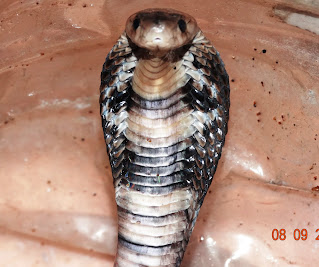
Spectacled
cobra│Naja naja, Linnaeus, 1758
The species is also known by names viz., The Indian
cobra, Asian cobra, Binocellate cobra. This species
of snake has a respected place in Indian culture & mythology which is often held by snake charmers in India, an illegal act since, it
is protected under the Indian
Wildlife Protection Act (1972). First description was given by Carl
Linnaeus (Zoologist,
Botanist & Physician) in the year 1758.
Scientific classification
Kingdom: Animalia
Phylum: Chordata
Class: Reptilia
Order: Squamata
Suborder: Serpentes
Family: Elapidae
Genus: Naja
Species: N. naja
This species of snake varies enormously
morphological throughout its geographical range. Indian cobras are of moderate
sized heavily bodied snakes. This species of cobra can be easily recognized by
impressive hood, while they expand it when threatened. Head of this species is
somewhat depressed, elliptical and slightly distinctive from its neck where snout
is small & rounded bearing large nostrils. Eyes are of medium size and are
black.
Bodies of the species possess smooth oval shaped scales. On dorsal side the color comprises brown, yellow, reddish, bluish, dark gray, black with blue. Lateral side of the snake’s scales is larger than other dorsal scales while the top scales are narrower. On the ventral side the color of body scales varies from milky yellowish-white to milky white, purple, brown & tint of red. The body coloration of these snakes mostly depends on their geographical region. Tail is little shorter in these snakes having pointed tip. These snakes can be found ranging from 3.3 to 4.9 ft. in length.
It inhabits a variety of habitats throughout its geographical range so can be sighted ranging from dense forests to open forests, from plains to agricultural domains, from rocky area to wetlands and in spite of these habitats these snakes can be found near and around residential areas from urban areas to villages. This species cannot be found desert region as it prefers to stay in the vicinity of water. Preferable hiding places are rat holes, termite mounds, hollows trees, rock crevices etc.
Characters
of species observed in Bhopal, MP
|
Characteristics
|
Range
|
Full
body length
|
234 mm- 1355
mm
|
Snout-vent
length
|
340 mm-1145 mm
|
Tail
length
|
80 mm-210 mm
|
Scalation
|
**Dorsal scales (A:M:P)
|
25:21:15-25:23:15
|
Supra-labial
scales (3rd
largest and in contact with nasal, 3rd and 4th in contact with eye)
|
7/7
|
Infra-labial
scales
|
8/8
|
Preocular
|
1
|
Postoculars
|
3
|
Temporals
|
2+3
|
Ventral
scales
|
170-194
|
Anal
scale
|
Single
|
Sub
caudal scales (Paired)
|
50- 65
|
**Note: A- Anterior; M-Midbody; P-Posterior
|
An Indian cobra shows oviparous reproduction and females lay their 10 and 30 eggs during
the months of April-July where they hatch after 48 to 69 days. The hatchlings
produced are between 8-12 inches in length & roam independently birth
onwards all of which have well developed venom glands. There are various myths
about snakes of Naja genus in India, including the notion that these snakes
mate with rat snakes of colubridae family. The cobras of Naja genus are significantly
respected and have special place in Hindu mythology as a deity.
The deity Shiva is always illustrated having a
cobra around his neck called Nag Vasuki signifying his mastery over "The
Maya or The world-illusion”. Lord Vishnu is also depicted to have a
deep relation with Nagaas, as resting on the coiled body of Nag Adishesha (a gigantic snake deity with
multiple cobra heads). They are also venerated during the Nag Panchami festival.
Throughout its huge geographical range it varies in colour and pattern. On the dorsal side the species color varies from dark brown to black, sometime bluish & belly milky white, grey, yellow, brown to reddish or even black and even bluish sometimes.
As I said, it is amongst the big four snakes of India, which are responsible for most of human deaths by snakebite in India subcontinent. Its venom is neurotoxic. Local symptom that appear after receiving cobra bite viz., swelling of the bitten area, weakening of limbs, paralyzing muscles, drooping of eyelids, vomiting, sweating & respiratory failure or cardiac arrest (ultimately to death). The venom of cobras is very fast acting which shows envenomation signs in 15 minutes and sometime takes upto 2 hours after the bite.
Its venom is itself used in the production of ant venom and even other researches viz., pain-killers and anti-cancer drugs. Even though this snake species is responsible for thousands of deaths but if quick medical treatment persuading anti-venom given properly than only fatalities can be controllable. There is polyvalent ant venom able now days which is used to cure snakebites. The species feed includes variety of animals (birds, bird eggs, small mammals, frogs, toads, lizards and even sometimes snakes too), but preys mostly on rodents that’s why they are mostly found near residential areas.
These species of snakes are not yet considered endangered, but face killing on false myths, because of fear & road kill. Other than this, they are also hunted for their skin possessing the unique hood markings which were used in the leather industry back then. The species is now protected under laws (Indian Wildlife Protection Act (1972) & listed in CITES.
The species is widely distribute around the world viz., India (Jammu & Kashmir, Andhra Pradesh, Chhattisgarh, Bihar, Tamil Nadu, Telangana, Uttar Pradesh, Uttarakhand, West Bengal, Jharkhand, Karnataka, Kerala, Gujarat, Assam, Madhya Pradesh, Delhi, Goa, Haryana, , Maharashtra, Meghalaya, Odisha, Pondicherry, Punjab & Sikkim), Sri Lanka, Pakistan, Myanmar, Bangladesh, Nepal, Eastern Afghanistan & Bhutan.
Literature Cited:
Boulenger, G.A. 1890. The fauna of British India including Ceylon and Burma, Reptilia and Batrachia. Taylor and Francis, London.
Dutta, S. K., and Acharjyo, L. N. 1995. Herpetofaunal resources and their conservation in Orissa, India. Zoos’ Print, 10 (7):5-8
Ganesh S. R., and Asokan J. R. (2010) Catalogue of Indian herpetological specimens in the collection of the Government Museum Chennai, India. Hamadryad, 35 (1):46 – 63
Ganesh, S. R., Chadramouli, S. R., Sreekar, R., and Shankar, P. G. 2013. Reptiles of the Central Western Ghats, India- a reappraisal and revised checklist, with emphasis on the Agumbe Plateau. Russian Journal of Herpetology. 20(2):134- 142
http://reptile-database.reptarium.cz/species?genus=Naja&species=naja
http://www.indiansnakes.org/content/spectacled-cobra
https://en.wikipedia.org/wiki/Indian_cobra
https://indiabiodiversity.org/species/show/238905
https://snake-facts.weebly.com/indian-cobra.html
Manhas, A., Kotwal, A., Wanganeo, R.R. and Wanganeo, A., 2015. Diversity, Threats and Conservation of Herpetofauna in and around Barkatullah University, Bhopal (MP), India. Int. J. Adv. Res. 3: 1546-1553.
Manhas, A., Raina, R. and Wanganeo, A. 2017. Current Status and Diversity of Ophidians (Reptilia: Squamata: Serpents) in Bhopal, Madhya Pradesh, Central India. Int. J. Cur. Micro. Appl. sci., 6 (5): 1384-1390.
Manhas, A., Raina, R. and Wanganeo, A. 2018. Reptilian diversity of the Bhopal region of state Madhya Pradesh of central India. IRCF Reptiles & Amphibians, 25 (2):104-114.
Manhas, A., Raina, R., and Wanganeo, A. 2016. An addition to the reptilian diversity of Barkatullah university campus, Bhopal, Madhya Pradesh, India. Int. J. Pure Appl. Zool., 4 (4): 306-309.
Manhas, A., Raina, R., and Wanganeo, A., 2015. Snakes of the Bhopal district, Madhya Pradesh, India with special reference to road mortality. J. Res. Biol., 5: 1868-1873.
Manhas, A., Raina, R., and Wanganeo, A., 2016. An assessment of reptilian diversity and their distribution in Jammu and Kashmir state from Jammu city in northern India: A case study. IJFBS 3: 20-23.
"Naja". Integrated Taxonomic Information System. Retrieved 10 August 2018.
Smith, M.A. 1943. The fauna of British India, Ceylon and Burma including the whole of the Indo-Chinese sub-region, Reptilia and Amphibia. Vol. III, Serpentes, Taylor & Francis, London.
Whitaker R., and Captain A. 2004. Snakes of India, “The Field Guide”. Draco Books, Chennai, India.
Whitaker, R. and Captain, A. 2008. Snakes of India, “The field guide”. Draco Books. Chennai, India Wüster, W.1996. "Taxonomic changes and toxinology: systematic revisions of the Asiatic cobras (Naja naja species complex)". Toxicon. 34(4):399–406.




.jpg)


